
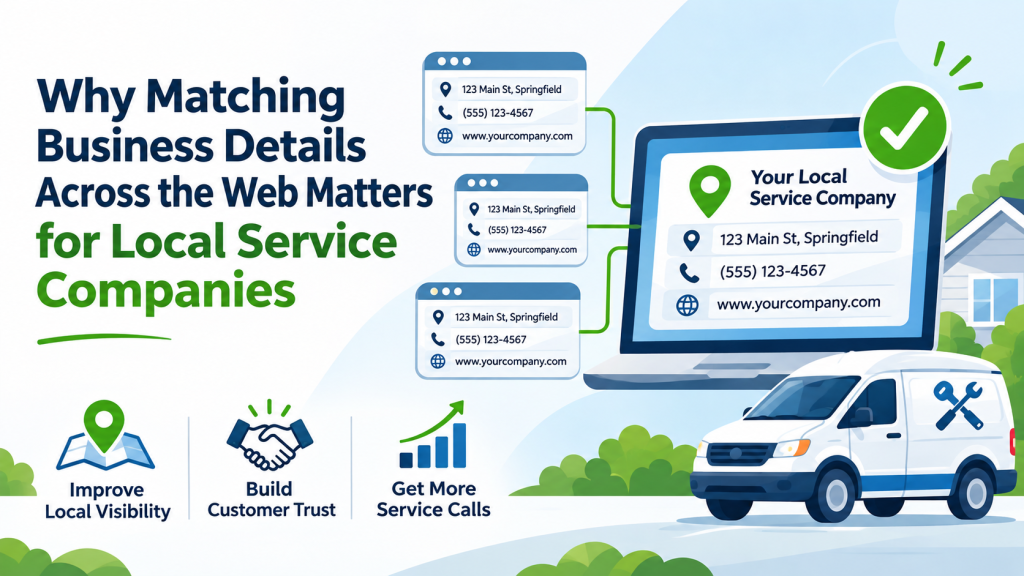
A homeowner with a burst pipe at 9 p.m. searches for an emergency plumber and finds your company in two places, each with a different phone number. One rings an old office line that nobody answers anymore. They hang up and call the next plumber on the list.
Small inconsistencies like this are easy to overlook, but for service businesses that depend on urgent calls, they can cost real jobs.
What a Business Citation Actually Is
A business citation is any online mention of your company’s name, address, and phone number, often shortened to NAP. Citations appear on your Google Business Profile, social media pages, review sites, trade associations, and online business directories. Some include a link to your website; many don’t.
Their main job is to help people find and confirm basic information about your business. When those details match everywhere, customers can trust what they see. When they conflict, people hesitate, and search platforms have a harder time confirming which version is correct.
Where Mismatched Listings Usually Come From
Most inconsistent citations aren’t careless mistakes. They build up over time. A plumbing company moves to a new shop, switches to a call-tracking number, or changes its name from “Smith Plumbing” to “Smith Plumbing & Drain LLC.” The website and Google Business Profile get updated, but older directory listings, the chamber of commerce page, and a supplier’s dealer locator still show the old details.
Minor formatting differences, such as “Suite 4” versus “Ste. 4,” are rarely a problem. A wrong street number, a disconnected phone line, or a closed location is.
A Practical Way to Clean Up Your Listings
Start with a simple spreadsheet. Write down your official business name, address, phone number, website, and hours exactly as you want them shown. Then search for your business name and every phone number you’ve used, and record each listing you find.
Work through the list in order of impact: your website and Google Business Profile first, then platforms such as Apple Business Connect, Bing Places, and Yelp, then industry and local directories. Google’s own guidance says local results depend mainly on how relevant, how close, and how well known a business is, so complete and accurate information supports the part you control.
When you add or update a listing on a directory such as downtownlists.com/, choose the category that matches your work. A plumbing company belongs among other local plumbing and plumber listings, where homeowners are already comparing options. Set a reminder to review every listing every few months and whenever something changes.
The Takeaway
Consistent citations won't guarantee more calls or higher rankings, but inconsistent details can quietly send customers to a competitor. Treat your NAP information like any other business record: keep one source of truth, update every listing when something changes, and check in regularly. An up-to-date profile on downtownlists.com/ is one more accurate place where local customers can confirm how to reach you.
Frequently Asked Questions
Do I need to list my business on every directory I can find?
No. Focus on quality and relevance over volume. Start with the major platforms, then add directories that are reputable, relevant to your industry or region, and actually used by customers. A smaller set of accurate, well-maintained listings is usually more useful than hundreds of thin profiles you can’t keep updated.
Should I use a call-tracking number in my listings?
Many businesses do, but handle it carefully. A common approach is to keep your main local number as the primary number on your Google Business Profile and add the tracking number as an additional phone where the platform allows it. On other listings, consistency matters more than tracking every single call.
What should I do about duplicate listings?
Duplicates confuse customers and can split your reviews between two profiles. Claim the listing you want to keep, then use the platform’s tools to report or merge the duplicate. Most major platforms, including Google, offer a way to flag duplicate profiles. Keep notes on what you changed so you can confirm the fix later.
How long do citation updates take to show up?
It varies by platform. Changes you make in a dashboard you control can appear within minutes or days, while updates that need editorial review may take weeks. Some data providers also share information with other sites on their own schedules, so recheck your listings a month or two after making changes.

Downtownlists.com Team
We help people find the best local businesses in their area and help businesses connect with local customers across the USA.